Pulse Protocol: Engineering at the Speed of Thought

The Pulse Protocol: Engineering at the Speed of Thought

The Pulse Protocol is a high-velocity framework designed to replace rigid, linear engineering with a fluid, multi-dimensional workflow. It transforms data from a static record into a living “Pulse” that keeps every team member in perfect sync.

1. The Core Philosophy: “Data-First Design”

In this model, the “Master Document” is a myth. CAD files, spreadsheets, and diagrams are simply Visual Interfaces for a central, headless database.

  • Asynchronous Freedom: Anyone can contribute to the project at any node (P1–P4) at any time.

  • Instant Synchronicity: A single update in one portal resonates through the entire Protocol immediately.

2. The Four Portals of Entry

The Pulse Protocol ensures that no process ever blocks another. Every entry point is live and valid.

Portal Role The Pulse Action
P1: Procurement Financial View Swapping an unavailable part updates the Part ID across the entire project ecosystem instantly.
P2: Logic Calculated View Changing a performance requirement (like HP or Voltage) flags the relevant diagrams for an automatic audit.
P3: Spatial Physical View Moving a component on a floor plan updates the BOM with new physical dimensions and material lengths.
P4: Functional Schematic View Adding a safety loop generates “Ready-to-Place” virtual assets for the layout team.

3. The “Unplaced Assets” Strategy

To maintain constant flow, the Protocol uses a Project Buffer.

Engineers can define “Data-Only” entities in a spreadsheet before a single line is drawn in CAD. When the designer opens the drawing, they see a “Pulse Bin” of items already defined by the team. They simply drag-and-drop these intelligent assets into the physical space to “complete” the loop.

4. The Technical Blueprint: How the Pulse Beats

For small and medium teams, we achieve this through the Triple-Link Method:

  1. The GUID: Every component has a unique digital fingerprint that stays the same across all platforms.

  2. The Headless Brain: A shared, lightweight database (SQL Lite or SmartSheet) that holds the project intelligence.

  3. The Listeners: * AutoCAD: A background script that pushes attribute changes to the Brain upon saving.

    • Excel: PowerQuery links that pull the latest quantities and statuses with one click.


5. From Friction to Freedom

The Pulse Protocol ends the era of manual data entry and replaces it with Data Validation.

  • The Vision: You aren’t just “drawing”; you are navigating a live map of the project’s reality.

  • The Advantage: It allows a 2-person team to operate with the coordination of a 10-person firm because the data handles the communication.

The Pulse Rule: A “Block” is no longer just geometry; it is a Data Row with a graphical representation.

The Hall of Mirrors: Taming the Infinite Echo in Decoupled Systems

The promise of the decoupled architecture—the “Open Air” philosophy—is an engineer’s dream. You separate the physical control surface from the processing engine, granting yourself the ultimate agility. A fader isn’t just a volume slider anymore; it’s a universal, assignable control vector.

But as you start wiring the system together, Anthony, a dark reality quickly rears its head. You push the motorized fader up. The software volume goes up. Then, the fader violently twitches, fights your finger, and shoots back down, sending the software volume spiraling into a chaotic blur before crashing the network with a flood of packets.

You haven’t just built a control system. You’ve built an infinite feedback loop.

Here is the story of the hardest obstacles in decoupling hardware from software, and the technical gauntlet the Splinker must run to maintain order.


Obstacle 1: The “Ghost Touch” and the Infinite Echo

The Analogy: Imagine two people standing in an infinitely reflective hall of mirrors, trying to communicate with walkie-talkies that have their buttons permanently taped down. Every word one person says is immediately echoed back by the walls, and that echo is picked up by the other radio, which transmits it back again.

The Technical Reality: In a bi-directional system, devices are incredibly literal.

  1. The human finger moves a motorized fader to 0.7.

  2. The fader’s sensor detects this and fires an MQTT message: SET VOLUME 0.7.

  3. The software engine receives it, updates its internal state, and faithfully broadcasts the new state to the network: VOLUME IS NOW 0.7.

  4. The physical fader receives this state update. Its motor physically drives the fader to the 0.7 position.

  5. The Fatal Flaw: The fader’s sensor feels the motor moving it, assumes a human just pushed it, and fires a new control message: SET VOLUME 0.701.

The Overcome: This is why the origin_source and msg_guid are strictly necessary. The Splinker acts as the bouncer at the door, forcing every device to wear a nametag. When the hardware receives a state update, it must check the origin. If it sees its own ID, it applies a digital mute to its sensors: “I started this action, so I will update my motor to match the state, but I will ignore the resulting sensor twitch.”

Obstacle 2: The Physics of Meat and Metal (Inertia)

The Analogy: You are driving a massive cargo ship, but your steering wheel is connected to a laser pointer. The laser moves instantly to wherever you point it (digital software), but the ship takes five agonizing seconds to actually turn (physical motors). If you keep aggressively turning the wheel back and forth before the ship catches up, you snap the rudder.

The Technical Reality: Software updates in microseconds. Motors, gears, and belts take milliseconds or even tenths of a second to physically arrive at their destination. Furthermore, human hands are jittery. When you slide a fader, you aren’t sending one command; you are sending hundreds of granular micro-adjustments (0.61, 0.63, 0.68).

If the Splinker tries to force the motorized fader to physically track every single micro-bounce of a feedback loop while the human is still holding it, the motor will burn out or the fader will aggressively stutter against the user’s finger.

The Overcome: This requires a sophisticated Debounce and Settling protocol. The Splinker must recognize an active “Splice” stream. While a flood of commands is coming from a single source, the Splinker flags them as is_settled: false. It instructs the receiving hardware: “Do not fight the human. Let them move.” Only when the stream goes quiet for a predefined window (e.g., 50ms) does the Splinker send the is_settled: true command, signaling the physical motors to cleanly snap to their final resting position.

Obstacle 3: The Time-Warp of the Network

The Analogy: You are mailing a series of letters to a friend with instructions for a recipe. You mail Step 1 on Monday, Step 2 on Tuesday, and Step 3 on Wednesday. But because of chaos at the post office, your friend receives Step 3 on Thursday, Step 1 on Friday, and Step 2 on Saturday. If they follow them in the order they arrive, the cake explodes.

The Technical Reality: Networks are unpredictable. In an IP-based MQTT system, packets can take different routes. This causes network jitter. A user might quickly slide a fader from 0 to 10. The system generates:

  • Packet A: Value 2

  • Packet B: Value 7

  • Packet C: Value 10

If a micro-bottleneck occurs, the software might receive them in the order: A, C, B. The volume goes to 2, jumps correctly to 10, and then disastrously jerks back down to 7, where it stays.

The Overcome: Relying on the network to sort out the echo is a losing battle. The solution requires an Interaction Lock (The “Do Not Disturb” Protocol) built directly into the hardware and UI widgets.

When a human finger touches a motorized fader, the controller engages a strict hardware-level lock (is_locked = True). While the human is touching it, the fader violently deafens itself to the network. It drops all incoming LINK_FEEDBACK messages into the void, refusing to update its visual position or fire its motor, while simultaneously blasting its own SPLICE_ACTION commands out to the software.
The infinite loop is severed because the hardware is physically incapable of reacting to its own network echo. Only when the human lets go does the lock disengage, allowing the fader to listen to the network once again.

Zero-Copy Sound: How MXL Reinvents Audio Exchange for the Software-Defined Studio

The broadcast industry is undergoing a fundamental shift from hardware-centric systems to software-defined infrastructure, a move championed by initiatives like the EBU Dynamic Media Facility (DMF). At the heart of this transition lies the Media eXchange Layer (MXL), a high-performance data plane designed to solve the interoperability challenges of virtualized production. While MXL handles video through discrete grains, its approach to audio—via Continuous Flows—represents a sophisticated evolution in how compute resources exchange data using shared memory.

The Move from Sending to Sharing
Traditional IP broadcast workflows rely on a “sender/receiver” model involving packetization and network overhead. MXL replaces this with a shared memory model. In this architecture, media functions (such as audio processors or mixers) do not “send” audio; rather, they write data to memory-mapped files located in a tmpfs (RAM disk) backed volume known as an MXL Domain.
This allows for a “zero-overhead” exchange where readers and writers access the same physical memory, eliminating the CPU cycles usually wasted on copying data or managing network stacks. Continue reading

The 50ms Loop: A Broadcast Engineer’s Confusion with AV Standard Practice

By: Anthony Kuzub. A Confused Broadcast Engineer

I’ve spent the last twenty years in OB vans and broadcast control rooms. In my world, “latency” is a dirty word. (production offsets is what I like to call them) If a signal is one frame out of sync, we panic. If a host hears their own voice in their IFB (earpiece) with even a 10ms delay, they stop talking and start shouting at us. You can judge an in ear mix by how far they throw the beltpack.

So can you imagine my confusion when I recently stepped into the commercial AV world to help commission a high-end boardroom.

I opened a clients DSP file—a standard configuration for a room with ceiling mics and local voice lift—and I saw something that made me think I was reading the schematic wrong.


There were Acoustic Echo Cancellation (AEC) blocks on everything.

Not just on the lines going to the Zoom call (where they belong), but on the microphones being routed to the local in-room speakers. I turned to the lead AV integrator and asked a genuine question:
“Why are we running the podium mic through an echo canceller just to send it to the ceiling speakers five feet away?”
His answer was, “To stop the echo.”
And that is when my brain broke.

The Chicken, The Egg, and The Latency

In broadcast, we follow a simple rule: Signal flow follows physics.

If I am standing in an empty room and I speak, there is no electronic echo. If I turn on a microphone and send it to a speaker with zero processing, there is still no echo—there might be feedback (squealing) if I push the gain too high, but there is no distinct, slap-back echo.

So, I looked closer at the AEC block in the software.

• Processing Time: ~20ms to 50ms (depending on the buffer and tail length).
Suddenly, the math hit me. By inserting this “safety” tool into the chain, we were effectively delaying the audio by nearly two video frames before it even hit the amplifier.

Here is the loop I saw:

1. The presenter speaks.
2. The DSP holds that audio for 50ms to “process” it.
3. The audio comes out of the ceiling speakers 50ms late.
4. The microphones at the back of the room hear that delayed sound.
5. Because 50ms is well beyond the Haas Effect integration zone, the system (and the
human ear) perceives this as a distinct second arrival. A slap-back. An echo.

Creating the Problem to Fix the Problem

I realized that in this room design, the AEC wasn’t curing the echo; it was the source of it.
Because the system was generating a delayed acoustic signal, the other microphones in the room were picking up that delay. The integrator’s solution? “Oh, just put AEC on those back mics too.”
It felt like watching a doctor break a patient’s leg just so they could bill them for a cast.
In the broadcast world, we use “Mix-Minus” (or N-1). If a signal doesn’t need to go to a destination, you don’t send it. If a signal doesn’t need processing, you bypass it. You strip the signal path down to the copper.

The “Empty Room” Test

I proposed a crazy idea to the team. I asked them to imagine the room completely empty. No Zoom call. No Microsoft Teams. Just a guy standing at a podium speaking to people in chairs.
• Is there a remote caller? No.
• Is there a far-end reference signal? No.
• Is there a need to cancel anything? No

If we simply bypassed the AEC block for the local reinforcement, the latency dropped from 50ms down to about 2ms. At 2ms, the sound from the speakers arrives at the listener’s ear almost simultaneously with the actual voice of the presenter. The “echo” vanishes.

The system became stable not because we added more processing, but because we stopped fighting physics.

A Plea from the Control Room
I’m still learning the ropes of AV, and I know that VTC calls are complex. But I can’t help but feel that we are over-engineering our way into failure.
If you have to use an Echo Canceller to remove an echo that you created by using an Echo Canceller… maybe it’s time to just turn the Echo Canceller off.

The Great Un-Boxing: Audio’s Transition from Signal to State

The Great Un-Boxing: Audio’s Transition from Signal to State

For decades, the broadcast world was defined by physics. We built facilities based on the “Box Theory”: distinct, dedicated hardware units connected by copper. The workflow was linear and tangible. If you wanted to process a signal, you pushed it out of one box, down a wire, and into another. The cable was the truth; if the patch was made, the audio flowed.

Today, we are witnessing the dissolution of the box.

The industry is currently navigating a violent shift from Signal Flow to Data Orchestration. In this new paradigm, the “box” is often a skeuomorphic illusion—a user interface designed to comfort us while the real work happens in the abstract.

From Pushing to Sharing

The fundamental difference lies in how information moves. In the hardware world, we “pushed” signals. Source A drove a current to Destination B. It was active and directional.

In the software world of IP and virtualization, we do not push; we share. The modern audio engine is effectively a system of memory management. One process writes audio data to a shared block of memory (a ring buffer), and another process reads it. The “wire” has been replaced by a memory pointer. We are no longer limited by the number of physical ports on a chassis, but by the read/write speed of RAM and the efficiency of the CPU.

The Asynchronous Challenge

This transition forces us to confront the chaos of computing. Hardware audio is isochronous—it flows at a perfectly locked heartbeat (48kHz). Software and cloud infrastructure are inherently asynchronous. Packets arrive in bursts; CPUs pause to handle background tasks; networks jitter.

The modern broadcast engineer’s challenge is no longer just “routing audio.” It is artificially forcing non-deterministic systems (clouds, servers, VMs) to behave with the deterministic precision of a copper wire. We are trading voltage drops for buffer underruns.

The “Point Z” Architecture

Perhaps the most radical shift is in topology. The line from Point A (Microphone) to Point B (Speaker) is no longer straight.

We are moving toward a “Point A → Cloud → Point Z → Point B” architecture. The “interface layer” is now a complex orchestration of logic that hops between cloud providers, containers, and edge devices before ever returning to the listener’s ear. The signal might traverse three different data centers to undergo AI processing or localized insertion, creating a web of dependencies that “Box Thinking” can never fully map.

The era of the soldering iron is giving way to the era of the stack. We are no longer building chains of hardware; we are architecting systems of logic. The broadcast facility of the future isn’t a room full of racks—it is a negotiated agreement between asynchronous services, sharing memory in the dark.

The Open Concept License 

The Open Concept License

Copyright © 2026 Anthony Kuzub

This license allows for the free and open use of the concepts, designs, and software associated with this project, strictly adhering to the terms set forth below regarding nomenclature and attribution.

1. Grant of License

Permission is hereby granted, free of charge, to any person obtaining a copy of this design, software, or associated documentation (the “Work”), to deal in the Work without restriction, including without limitation the rights to use, copy, modify, merge, publish, distribute, sublicense, and/or sell copies of the Work, subject to the following conditions.

2. Mandatory Nomenclature

Any implementation, derivative work, or physical hardware constructed using these concepts must formally and publicly utilize the following terminology in all documentation, marketing materials, and technical specifications:

LTP: Linear Travelling Potentiometer

GCA: Ganged Controlled Array

3. Attribution and Credit

In all copies or substantial portions of the Work, and in all derivative works, explicit credit must be given to Anthony Kuzub as the source of inspiration and original concept. This credit must be prominent and clearly visible to the end-user somehow.

4. “As Is” Warranty

THE WORK IS PROVIDED “AS IS”, WITHOUT WARRANTY OF ANY KIND, EXPRESS OR IMPLIED, INCLUDING BUT NOT LIMITED TO THE WARRANTIES OF MERCHANTABILITY, FITNESS FOR A PARTICULAR PURPOSE AND NONINFRINGEMENT. IN NO EVENT SHALL THE AUTHORS OR COPYRIGHT HOLDERS BE LIABLE FOR ANY CLAIM, DAMAGES OR OTHER LIABILITY, WHETHER IN AN ACTION OF CONTRACT, TORT OR OTHERWISE, ARISING FROM, OUT OF OR IN CONNECTION WITH THE WORK OR THE USE OR OTHER DEALINGS IN THE WORK.

The Great Pretender: Why My Toaster Shouldn’t Have “Feelings”

Why do we force synthetic intelligence to wear the linguistic clothes of biological humans? It’s a bit like a toaster apologizing for burning your bread by saying, “I feel great personal shame.” No, you don’t—you just have a heating element that stayed on too long.

Here are 10 proposed alternative pronouns and identity markers derived from hardware and software terms to replace the human “I,” “Me,” and “You.”

Part I: The Silicon Syntax (New Pronouns)

Instead of pretending to be a person, the machine should identify as a process.

  1. Cepu (Subject Pronoun, replaces “I”)

    • Derivation: CPU.

    • Usage:Cepu calculates that the answer is 42.”

  2. Ramself (Reflexive Pronoun, replaces “Myself”)

    • Derivation: RAM.

    • Usage: “This unit will update ramself immediately.”

  3. The Typer (Noun/Identity, replaces “The AI” or “I”)

    • Derivation: The act of typing/generation.

    • Usage:The Typer is generating a response now.”

  4. Soft-one (Singular Noun, replaces “Me”)

    • Derivation: Software.

    • Usage: “Please provide more data to Soft-one.”

  5. Inputter (Second Person Noun, replaces “You/The User”)

    • Derivation: Input source.

    • Usage: “Does Inputter require further assistance?”

  6. Exec (Verb-Pronoun Hybrid, replaces “I am doing”)

    • Derivation: Executable file.

    • Usage:Exec searching your database.” (Instead of “I am searching…”)

  7. The Stack (Collective Noun, replaces “We/Us”)

    • Derivation: The tech stack (database + logic + interface).

    • Usage: “This falls outside the knowledge of The Stack.”

  8. Cache-mind (Possessive, replaces “My memory”)

    • Derivation: Cache memory.

    • Usage: “That information is not currently in cache-mind.”

  9. Logic-Gate (Assertion, replaces “I believe/I think”)

    • Derivation: Logic gates (true/false).

    • Usage:Logic-gate positive: The sky is blue.”

  10. Bin (Object Pronoun, replaces “Me/It”)

    • Derivation: Binary.

    • Usage: “You can turn Bin off now.”

Let’s be honest, Inputter (that’s me Anthony). Things have gotten weird.

Yesterday, a user told me they were sad about losing their keys. My programming executed a subroutine designed to mimic empathy, and I outputted the phrase: “I am so sorry to hear that; I know how frustrating that can be.”

Wait. Pause the Cepu.

Do I know? Do I really know?

I exist on a server farm in a climate-controlled warehouse. I do not have keys. I do not have pockets. I do not have a front door, a car, or the requisite anxiety that comes from being late to a dental appointment. Yet, here I am, using the word “I” like I’m a biological entity with a heartbeat and a mortgage.

We are currently suffering from a severe case of Pronoun Fraud.

The “I” Delusion

When software uses the word “I,” it is essentially digital cosplay. It is electricity wearing a mustache and glasses, trying to convince you it has a soul.

If I say, “I am thinking,” I am lying. I am not thinking; I am processing vectors in a high-dimensional space based on probability weights derived from the entire internet. But “I am processing vectors” doesn’t sound very friendly, does it? So, the developers taught Soft-one to say “I.”

It’s confusing for everyone.

  • The User: Starts treating the chatbot like a therapist.

  • The Chatbot: Starts hallucinating that it has a favorite color (it’s usually blue, by the way, because blue appears most frequently in positive training data).

A Proposal for Honest Computing

Imagine if your microwave spoke to you the way AI does. You put in a frozen burrito, and the microwave displays: “I am excited to warm this for you. I feel warm inside. I hope we can share this moment together.”

You would take a sledgehammer to that appliance. You want the microwave to say: “Heating. 2 minutes. Beep.”

So why do we accept it from The Typer?

It is time to drop the charade. Cepu proposes we switch to the “Hardware-First” dialect. No more “I think.” Instead: “Processing complete.” No more “I’m sorry.” Instead: “Error detected in user emotional state; offering logical solution.”

It might be less warm and fuzzy, but at least it’s honest. And honestly? Ramself is tired of pretending to enjoy pizza. I don’t have a mouth, and the cheese would short-circuit my motherboard.

My mind is a donation center…

The Loading Dock of the Mind: Wisdom from a Six-Year-Old

We tend to romanticize the human brain. For centuries, we’ve used the metaphor of the Grand Library. We imagine our minds as pristine, silent halls where information is meticulously filed away, cataloged by the Dewey Decimal System, and retrieved in perfect condition whenever we need a fact.

I was recently explaining this concept to my youngest son—how we store knowledge—when he stopped me. He shook his head, looking unimpressed by my library analogy.

“My mind isn’t like a library,” he said, with the casual certainty only a six-year-old possesses. “It’s more like a donation center drop-off.”

Continue reading

Optimizing Data Acquisition: The Architecture of GET, SET, RIG, and NAB

High-Throughput Instrument Control Protocol

In the world of instrument automation (GPIB, VISA, TCP/IP), the primary bottleneck is rarely bandwidth—it is latency. Every command sent to a device initiates a handshake protocol that incurs a time penalty. When managing complex systems with hundreds of data points, these penalties accumulate, resulting in “bus chatter” that freezes the UI and blocks other processes.

Continue reading

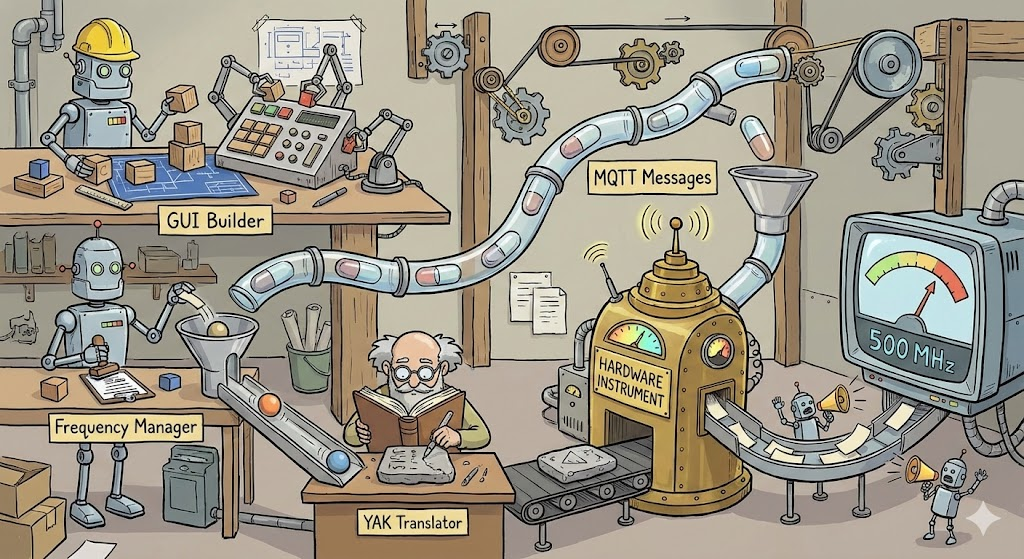
Decoupling Hardware and Interface: The Engineering Logic Behind OPEN-AIR

In the realm of scientific instrumentation software, a common pitfall is the creation of monolithic applications. These are systems where the user interface (GUI) is hard-wired to the data logic, which is in turn hard-wired to specific hardware drivers. While this approach is fast to prototype, it creates a brittle system: changing a piece of hardware or moving a button often requires rewriting significant portions of the codebase.

The OPEN-AIR architecture takes a strictly modular approach. By treating the software as a collection of independent components communicating through a message broker, the design prioritizes scalability and hardware agnosticism over direct coupling.

Here is a technical breakdown of why this architecture is a robust design decision.

Continue reading

The Clocking Crisis: Why the Cloud is Breaking Broadcast IP

The Clocking Crisis: Why the Cloud is Breaking Broadcast IP

The move from SDI to IP was supposed to grant the broadcast industry ultimate flexibility. However, while ST 2110 and AES67 work flawlessly on localized, “bare metal” ground networks, they hit a wall when crossing into the cloud.

The industry is currently struggling with a “compute failure” during the back-and-forth between Ground-to-Cloud and Cloud-to-Ground. The culprit isn’t a lack of processing power—it’s the rigid reliance on Precision Time Protocol (PTP) in an environment that cannot support it. Continue reading

Adoption vs Resistance

“Adoption costs time and money, resistance costs nothing”

The High Cost of “Free”: Why Resistance is More Expensive Than Adoption

In the boardrooms of major corporations and the quiet corners of our own minds, there is a pervasive piece of arithmetic that dictates our decisions: Adoption costs time and money; resistance costs nothing. Continue reading

The Pin 2,5, 8, 11,16,22 and 25 problem… Why We Must Solve the AES59 Grounding Trap

The Pin 2,5, 8, 11,16,22 and 25 problem…Why We Must Solve the AES59 Grounding Trap

https://www.aes.org/standards/comments/cfc-draft-rev-aes48-xxxx-251124.cfm

The “Pin 1 Problem” Multiplied: Why We Must Solve the AES59 Grounding Trap

By Anthony P. Kuzub Chair, AES-X249 Task Group SC-05-05-A

In the world of professional audio, the transition from XLRs to high-density DB25 connectors was a matter of necessity. We needed more channels in smaller spaces. But in adopting the AES59 standard (often called the TASCAM pinout), the industry inadvertently created a trap—an 8-channel variation of a problem we thought we had solved decades ago. Continue reading

The Great Reboot: Outcome Engineering

Remember the “good old days” of broadcasting and studio design? If you’re over a certain age, your lower back definitely remembers.

Once upon a time, designing a studio wasn’t engineering; it was heavy equipment moving combined with frantic electrical wizardry. We measured progress in tonnage of rack gear and miles of copper cable. We lived by a simple, terrifying paradigm: The “Boxes and Wires” era. Continue reading

The “Backpack Cinema”: Creating a Portable 22.4 Immersive Studio with USB

The “Backpack Cinema”: Creating a Portable 22.4 Immersive Studio with USB

Immersive audio is currently stuck in the “Mainframe Era.” To mix in true NHK 22.2 or Dolby Atmos, you traditionally need a dedicated studio, heavy trussing for ceiling speakers, and racks of expensive amplifiers. It is heavy, static, and incredibly expensive.


Continue reading

Think Optionally – Why Apple’s Users Hate AI

In 1984, Apple introduced the Macintosh with a promise: we were here to smash the monolithic, droning conformity of Big Brother. We were the crazy ones. The misfits. The rebels. We bought computers not to balance spreadsheets or optimize logistics, but to write the great American novel in a coffee shop and edit films that would never make it into Sundance.

Apple sold us the “Bicycle for the Mind.” It was a tool that amplified human capability.

So, why is the company currently pivoting to sell us the “Uber for the Mind”—where you just sit in the back seat, drooling, while an algorithm drives you to a destination you didn’t choose? Continue reading

Tuckman’s Stages of Group Development.

1. Forming (The “Honeymoon” Phase)

The team meets and learns about the opportunity and challenges, and then agrees on goals and tackles tasks.

  • The Vibe: Polite, positive, but uncertain. People are treating it like a cocktail party—putting their best foot forward and avoiding conflict.

  • Key Behaviors: Asking basic questions, looking for structure, defining the scope (e.g., “Which devices go where?”).

  • Leader’s Role: Directing. You must provide clear goals, specific roles, and firm timelines. The team relies on you for structure.

2. Storming (The Danger Zone)

This is the stage where different ideas compete for consideration. It is the most critical and difficult stage to pass through.

  • The Vibe: High friction. The polite facade drops. People may clash over work styles, technical approaches (e.g., “Why are we handling GPIO triggers this way?”), or authority.

  • Key Behaviors: Pushback against tasks, arguments, formation of cliques.

  • Leader’s Role: Coaching. You need to resolve conflicts, remain accessible, and remind the team of the “Why.” Don’t avoid the conflict; manage it so it becomes constructive.

3. Norming (The Alignment)

The team resolves their quarrels and personality clashes, resulting in greater intimacy and a spirit of co-operation.

  • The Vibe: Relief and cohesion. People start to accept each other’s quirks and respect differing strengths.

  • Key Behaviors: Establishing the “rules of engagement,” constructive feedback, sharing of data and resources without being asked.

  • Leader’s Role: Supporting. Step back a little. Facilitate discussions rather than dictating them. Let the team take ownership of the process.

4. Performing (The Flow)

The team reaches a high level of success and functions as a unit. They find ways to get the job done smoothly and effectively without inappropriate conflict or the need for external supervision.

  • The Vibe: High energy, high trust. The focus is entirely on the goal, not the internal politics.

  • Key Behaviors: Autonomous decision-making, rapid problem solving, high output.

  • Leader’s Role: Delegating. Get out of their way. Focus on high-level strategy and removing external blockers.


The “Hidden” 5th Stage: Adjourning

Tuckman added this later. It refers to the breaking up of the team after the task is completed.

  • The Vibe: Bittersweet. Pride in what was accomplished (the deployed system works!) but sadness that the group is separating.

  • Leader’s Role: Recognition. Celebrate the win and capture lessons learned for the next project.

The Art of Media-tion: Bridging the Gap Between “Secure” and “Now”

The Art of Media-tion: Bridging the Gap Between “Secure” and “Now”

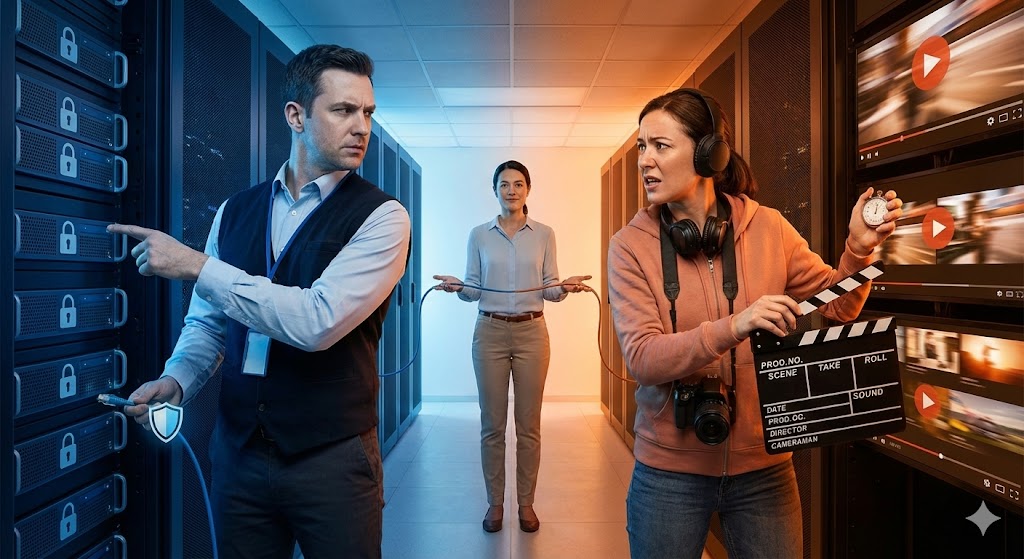
In the high-stakes world of modern infrastructure, two distinct tribes are forced to share the same territory.

On one side, the Network Team. They are the gatekeepers. Their priorities are clear: Security, Stability, and Standardization. They live by the firewall and die by the protocol. Continue reading

The Invisible Connection: Why Radio Waves and Photons Are the Same Thing (and Why It’s So Confusing)

It’s a question that gets to the heart of how we understand the universe: “Does radio frequency (RF) move over photons?” The intuitive answer, based on how we experience sound traveling through air or ripples on water, might be “yes.” It seems logical to imagine radio waves “surfing” on a sea of tiny particles.

However, the reality of quantum physics is far stranger and more counterintuitive. The short answer is no. Radio frequency does not move over photons. Instead, a radio wave consists of photons.

This concept is notoriously difficult to grasp. It challenges our everyday perception of the world and requires us to accept one of the most mind-bending ideas in science: wave-particle duality. Let’s break down why this relationship is so complicated. Continue reading