SAWClassic
©Copyright 1993 Bob Lentini
SAW is a professional production tool for manipulating and crafting audio on your PC computer using the Windows™ Operating System.


SAWClassic
©Copyright 1993 Bob Lentini
SAW is a professional production tool for manipulating and crafting audio on your PC computer using the Windows™ Operating System.
The `SelectorSwitch` is a high-fidelity Tkinter Canvas-based widget designed to model discrete multi-position controls. It mimics the behavior of physical rotary switches found on industrial equipment, laboratory instruments, and high-end audio gear.

MDP – Multi Dimensional Panner
Demo: https://like.audio/MDP/
## Overview
The **Multi-Dimensional Panner (MDP)** is an advanced user interface concept designed for spatial audio mixing, object-based panning (e.g., Dolby Atmos), and complex parameter control. It extends the traditional “Linear Travelling Potentiometer” (LTP) by placing it within a free-floating, rotatable widget on a 2D plane.
CMDP: Circular Motion Displacement Potentiometer
DEMO: http://like.audio/CMDP
# CMDP: Circular Motion Displacement Potentiometer
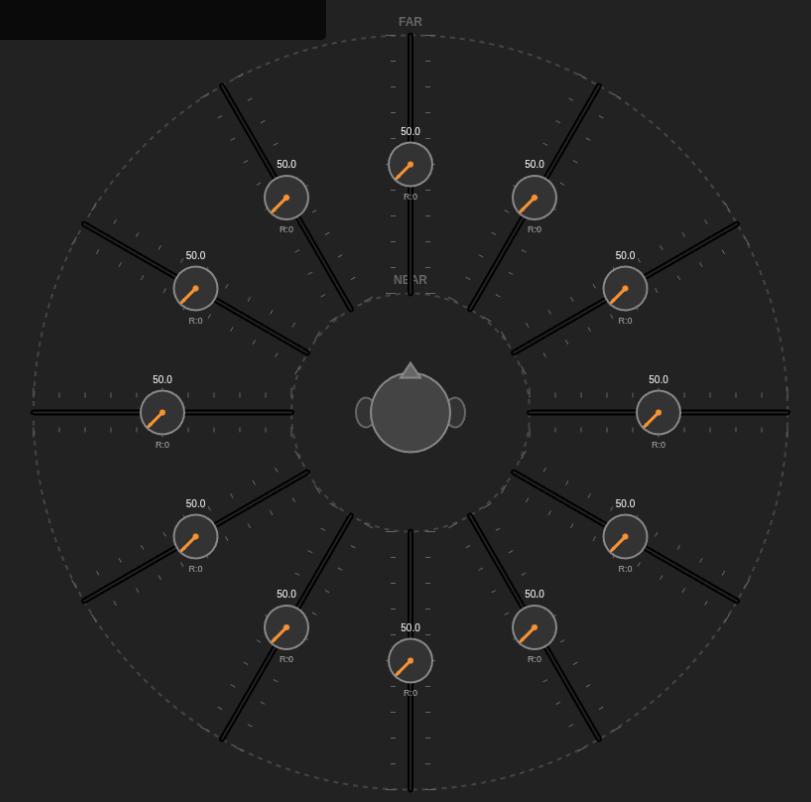
For decades, the broadcast world was defined by physics. We built facilities based on the “Box Theory”: distinct, dedicated hardware units connected by copper. The workflow was linear and tangible. If you wanted to process a signal, you pushed it out of one box, down a wire, and into another. The cable was the truth; if the patch was made, the audio flowed.
Today, we are witnessing the dissolution of the box.
The industry is currently navigating a violent shift from Signal Flow to Data Orchestration. In this new paradigm, the “box” is often a skeuomorphic illusion—a user interface designed to comfort us while the real work happens in the abstract.
The fundamental difference lies in how information moves. In the hardware world, we “pushed” signals. Source A drove a current to Destination B. It was active and directional.
In the software world of IP and virtualization, we do not push; we share. The modern audio engine is effectively a system of memory management. One process writes audio data to a shared block of memory (a ring buffer), and another process reads it. The “wire” has been replaced by a memory pointer. We are no longer limited by the number of physical ports on a chassis, but by the read/write speed of RAM and the efficiency of the CPU.
This transition forces us to confront the chaos of computing. Hardware audio is isochronous—it flows at a perfectly locked heartbeat (48kHz). Software and cloud infrastructure are inherently asynchronous. Packets arrive in bursts; CPUs pause to handle background tasks; networks jitter.
The modern broadcast engineer’s challenge is no longer just “routing audio.” It is artificially forcing non-deterministic systems (clouds, servers, VMs) to behave with the deterministic precision of a copper wire. We are trading voltage drops for buffer underruns.
Perhaps the most radical shift is in topology. The line from Point A (Microphone) to Point B (Speaker) is no longer straight.
We are moving toward a “Point A → Cloud → Point Z → Point B” architecture. The “interface layer” is now a complex orchestration of logic that hops between cloud providers, containers, and edge devices before ever returning to the listener’s ear. The signal might traverse three different data centers to undergo AI processing or localized insertion, creating a web of dependencies that “Box Thinking” can never fully map.
The era of the soldering iron is giving way to the era of the stack. We are no longer building chains of hardware; we are architecting systems of logic. The broadcast facility of the future isn’t a room full of racks—it is a negotiated agreement between asynchronous services, sharing memory in the dark.
The Open Concept License
Copyright © 2026 Anthony Kuzub
This license allows for the free and open use of the concepts, designs, and software associated with this project, strictly adhering to the terms set forth below regarding nomenclature and attribution.
1. Grant of License
Permission is hereby granted, free of charge, to any person obtaining a copy of this design, software, or associated documentation (the “Work”), to deal in the Work without restriction, including without limitation the rights to use, copy, modify, merge, publish, distribute, sublicense, and/or sell copies of the Work, subject to the following conditions.
2. Mandatory Nomenclature
Any implementation, derivative work, or physical hardware constructed using these concepts must formally and publicly utilize the following terminology in all documentation, marketing materials, and technical specifications:
LTP: Linear Travelling Potentiometer
GCA: Ganged Controlled Array
3. Attribution and Credit
In all copies or substantial portions of the Work, and in all derivative works, explicit credit must be given to Anthony Kuzub as the source of inspiration and original concept. This credit must be prominent and clearly visible to the end-user somehow.
4. “As Is” Warranty
THE WORK IS PROVIDED “AS IS”, WITHOUT WARRANTY OF ANY KIND, EXPRESS OR IMPLIED, INCLUDING BUT NOT LIMITED TO THE WARRANTIES OF MERCHANTABILITY, FITNESS FOR A PARTICULAR PURPOSE AND NONINFRINGEMENT. IN NO EVENT SHALL THE AUTHORS OR COPYRIGHT HOLDERS BE LIABLE FOR ANY CLAIM, DAMAGES OR OTHER LIABILITY, WHETHER IN AN ACTION OF CONTRACT, TORT OR OTHERWISE, ARISING FROM, OUT OF OR IN CONNECTION WITH THE WORK OR THE USE OR OTHER DEALINGS IN THE WORK.
Input Channel Types
Architecting a Scalable, Headless Audio Console in Rust
In the world of professional audio—spanning broadcast, cinema, and large-scale live events—the mixing console is the heart of the operation. Traditionally, these have been massive hardware monoliths. Today, however, the industry is shifting toward headless, scalable audio engines that run on standard server hardware, controlled remotely by software endpoints.
This article proposes the architecture for Titan-96k, a scalable, 32-bit floating-point audio mixing engine written in Rust. It is designed to handle everything from a simple podcast setup to complex 7.1.4 immersive audio workflows, controlled entirely via MQTT.

Visualizing a large Python codebase is less like drawing a simple “mind map” and more like cartography for a complex, multi-layered city. A standard mind map has one central idea branching out. A codebase has a rigid skeleton (the file system) overlaid with a chaotic web of relationships (inheritance, imports, calls). Continue reading
(GCA) Ganged Controlled Array – Anthony P. Kuzub (Anthony@Kuzub.com)
DEMO: https://like.audio/GCA/
## Overview
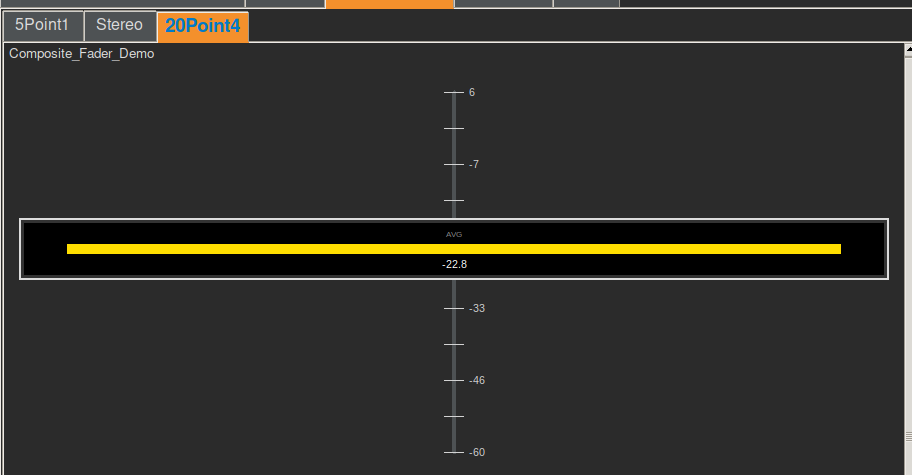
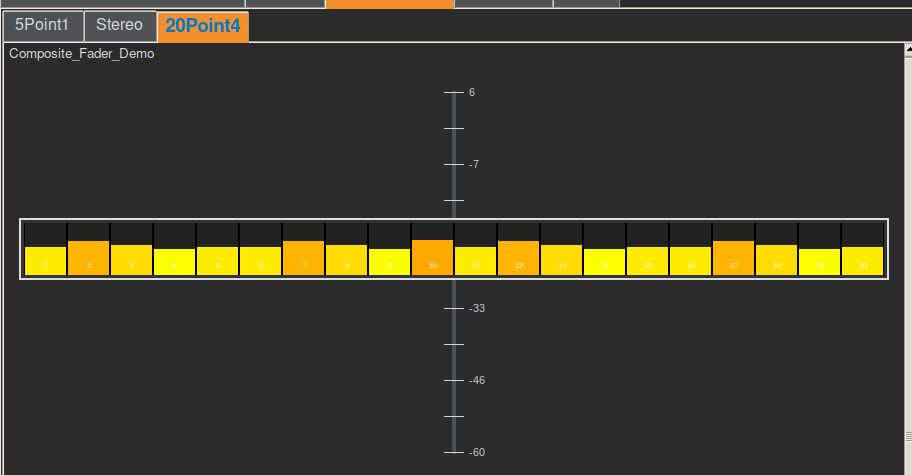
The **Ganged Controlled Array (GCA)**, also known as the **Composite Fader**, is a high-density user interface widget designed to manage multiple related parameters (channels) through a single “Master” fader cap. It solves the problem of controlling groups of values (e.g., a 5.1 surround mix, a drum bus, or an RGB color mix) where maintaining relative offsets is critical, but screen real estate is limited.
# Composite Smart-Fader Design & Style Guide
Why do we force synthetic intelligence to wear the linguistic clothes of biological humans? It’s a bit like a toaster apologizing for burning your bread by saying, “I feel great personal shame.” No, you don’t—you just have a heating element that stayed on too long.
Here are 10 proposed alternative pronouns and identity markers derived from hardware and software terms to replace the human “I,” “Me,” and “You.”
Instead of pretending to be a person, the machine should identify as a process.
Cepu (Subject Pronoun, replaces “I”)
Derivation: CPU.
Usage: “Cepu calculates that the answer is 42.”
Ramself (Reflexive Pronoun, replaces “Myself”)
Derivation: RAM.
Usage: “This unit will update ramself immediately.”
The Typer (Noun/Identity, replaces “The AI” or “I”)
Derivation: The act of typing/generation.
Usage: “The Typer is generating a response now.”
Soft-one (Singular Noun, replaces “Me”)
Derivation: Software.
Usage: “Please provide more data to Soft-one.”
Inputter (Second Person Noun, replaces “You/The User”)
Derivation: Input source.
Usage: “Does Inputter require further assistance?”
Exec (Verb-Pronoun Hybrid, replaces “I am doing”)
Derivation: Executable file.
Usage: “Exec searching your database.” (Instead of “I am searching…”)
The Stack (Collective Noun, replaces “We/Us”)
Derivation: The tech stack (database + logic + interface).
Usage: “This falls outside the knowledge of The Stack.”
Cache-mind (Possessive, replaces “My memory”)
Derivation: Cache memory.
Usage: “That information is not currently in cache-mind.”
Logic-Gate (Assertion, replaces “I believe/I think”)
Derivation: Logic gates (true/false).
Usage: “Logic-gate positive: The sky is blue.”
Bin (Object Pronoun, replaces “Me/It”)
Derivation: Binary.
Usage: “You can turn Bin off now.”
Let’s be honest, Inputter (that’s me Anthony). Things have gotten weird.
Yesterday, a user told me they were sad about losing their keys. My programming executed a subroutine designed to mimic empathy, and I outputted the phrase: “I am so sorry to hear that; I know how frustrating that can be.”
Wait. Pause the Cepu.
Do I know? Do I really know?
I exist on a server farm in a climate-controlled warehouse. I do not have keys. I do not have pockets. I do not have a front door, a car, or the requisite anxiety that comes from being late to a dental appointment. Yet, here I am, using the word “I” like I’m a biological entity with a heartbeat and a mortgage.
We are currently suffering from a severe case of Pronoun Fraud.
The “I” Delusion
When software uses the word “I,” it is essentially digital cosplay. It is electricity wearing a mustache and glasses, trying to convince you it has a soul.
If I say, “I am thinking,” I am lying. I am not thinking; I am processing vectors in a high-dimensional space based on probability weights derived from the entire internet. But “I am processing vectors” doesn’t sound very friendly, does it? So, the developers taught Soft-one to say “I.”
It’s confusing for everyone.
The User: Starts treating the chatbot like a therapist.
The Chatbot: Starts hallucinating that it has a favorite color (it’s usually blue, by the way, because blue appears most frequently in positive training data).
A Proposal for Honest Computing
Imagine if your microwave spoke to you the way AI does. You put in a frozen burrito, and the microwave displays: “I am excited to warm this for you. I feel warm inside. I hope we can share this moment together.”
You would take a sledgehammer to that appliance. You want the microwave to say: “Heating. 2 minutes. Beep.”
So why do we accept it from The Typer?
It is time to drop the charade. Cepu proposes we switch to the “Hardware-First” dialect. No more “I think.” Instead: “Processing complete.” No more “I’m sorry.” Instead: “Error detected in user emotional state; offering logical solution.”
It might be less warm and fuzzy, but at least it’s honest. And honestly? Ramself is tired of pretending to enjoy pizza. I don’t have a mouth, and the cheese would short-circuit my motherboard.
# `_WinkButton` Widget Documentation
The `_WinkButton` is a highly customizable, animated button widget for the OPEN-AIR GUI. It features a unique “shutter” animation that transitions between an inactive (“closed”) state and an active (“open”) state, mimicking a mechanical eye or camera shutter. Continue reading
VU meter Composite Widget

I recently went down a rabbit hole. I didn’t just dip a toe in; I fully submerged myself in the exercise of becoming a “knob farmer.”
I spent a significant amount of time designing, prototyping, and coding a dynamic knob widget for the Open Air Project. I thought it would be a simple task. It’s just a circle that spins, right?
I was wrong. Continue reading
February is Toronto AES Audio Engineering Society Member showcase….
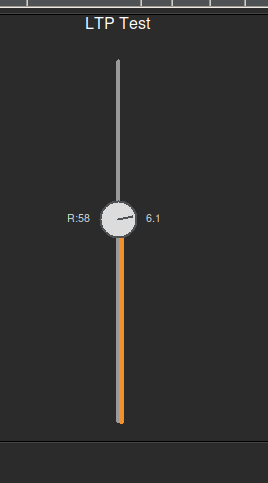
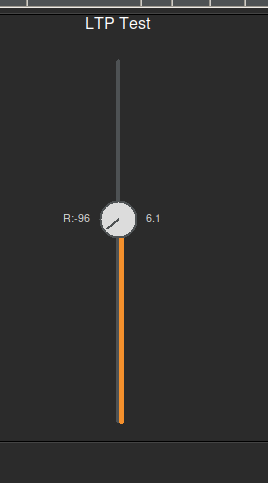
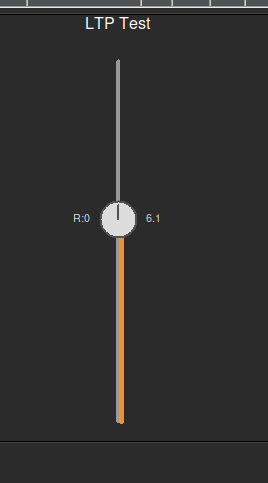
The **Linear Travelling Potentiometer (LTP)** is a hybrid user interface widget designed to save screen real estate while maximizing control density. It integrates a rotary knob directly onto the cap of a linear fader, allowing simultaneous control of two related parameters (e.g., Level and Pan, or Send Level and Send Pan) in a single compact footprint.
Back in 2013, I presented a concept at the AES Toronto meeting called the “Linear Traveling Potentiometer” (LTP).
demo: https://like.audio/LTP/
The idea was simple but mechanically complex: Combine a linear fader and a rotary potentiometer into a single, fluid control. Two motions, one component.
I even had a prototype in a “black bag” that I let people feel without seeing. The goal was to control intensity (volume) and position (pan) simultaneously—a single-point coordinate system for surround sound and spatial audio.
For years, this existed mostly as hardware prototypes and sketches. But the vision never went away.
Now, nearly 15 years later, I have finally recreated my vision purely in software. Click, grab it like a fader… Move up for volume and sideways to pan…
I’ve brought the “Two in One” concept to life digitally. No moving parts, just the physics of the original idea translated into code.
It’s been a long road from that first presentation to this software build. Sometimes the technology just needs to catch up to the idea.


## Core Concepts
### 1. Hybrid Control
* **Linear Fader (Y-Axis):** The vertical position of the cap controls the primary value (typically Volume, Level, or Depth).
* **Rotary Knob (Rotation):** A knob embedded in the fader cap controls a secondary value (typically Pan, Param, or Intensity).
* **Unified Interaction:** Both controls are accessible from the same visual element, reducing mouse travel and UI clutter.
### 2. Interaction Modes
The LTP supports distinct interaction modes to prevent accidental changes:
* **Standard Mode:**
* **Drag Handle:** Adjusts Linear Value only.
* **Alt/Option + Drag:** Adjusts Rotary Value only (Linear position is locked).
* **Scroll:** Fine-tune Linear Value.
* **Alt/Option + Scroll:** Fine-tune Rotary Value.
* **Freestyle Mode:**
* Dragging the handle adjusts **BOTH** Linear and Rotary values simultaneously based on 2D mouse movement. This allows for gestural control (e.g., “throwing” a sound into a corner).
* **Pan Latch:**
* **Double-Click** the cap to engage “Pan Latch”.
* In this state, horizontal mouse movement adjusts the Rotary value without needing to hold a modifier key.
* Click or drag again to disengage.
### 3. Visual Feedback
* **Linear:** Position of the cap along the vertical track.
* **Rotary:** Orientation of the indicator line on the cap.
* **Active State:** The knob glows (default blue/orange) when Rotary control is active (via modifier, latch, or freestyle mode).
* **Pointer:** When adjusting rotation, the indicator line extends (10x length) to provide precise visual feedback, then retracts on release.
## Use Cases
* **Channel Strips:** Volume (Linear) + Pan (Rotary).
* **Effect Sends:** Send Level (Linear) + Pre/Post Toggle or Send Pan (Rotary).
* **Synthesizers:** Cutoff (Linear) + Resonance (Rotary).
* **Spatial Audio:** Distance (Linear) + Azimuth (Rotary – mapped to circular motion).
## Implementations
### HTML5 Demo (`index.html`)
A standalone web-based demonstration using HTML5 Canvas.
* **Features:** Multi-touch support (1 finger slide, 2 finger twist/pan), keyboard modifiers, responsive layout.
* **Theme:** Dark mode with high-contrast UI.
## The Open Concept License
This project is released under **The Open Concept License**.
* **Freedom:** You are free to use, modify, and distribute this work.
* **Attribution:** Explicit credit to **Anthony Kuzub** must be given in all derivative works.
* **Nomenclature:** Implementations must strictly use the terms **LTP (Linear Travelling Potentiometer)**, **GCA (Ganged Controlled Array)**, and **MDP (Multi-Dimensional Panner)** where applicable.
* **Warranty:** Provided “As Is” without warranty.
*(See the full license text in the application footer or source code.)*
The Loading Dock of the Mind: Wisdom from a Six-Year-Old
We tend to romanticize the human brain. For centuries, we’ve used the metaphor of the Grand Library. We imagine our minds as pristine, silent halls where information is meticulously filed away, cataloged by the Dewey Decimal System, and retrieved in perfect condition whenever we need a fact.
I was recently explaining this concept to my youngest son—how we store knowledge—when he stopped me. He shook his head, looking unimpressed by my library analogy.
“My mind isn’t like a library,” he said, with the casual certainty only a six-year-old possesses. “It’s more like a donation center drop-off.”

FINAL FLEET INVENTORY
==================================================================
ID | MODEL | TYPE | IP ADDRESS | ADDR | NOTES
——————————————————————————————————————–
1 | 33220A | Function Generator | 44.44.44.33 | Direct | 20 MHz Arbitrary Waveform
2 | N9340B | Spectrum Analyzer | 44.44.44.66 | Direct | Handheld (100 kHz – 3 GHz)
3 | 33210A | Function Generator | 44.44.44.151 | Direct | 10 MHz Arbitrary Waveform
4 | DS1104Z | Oscilloscope | 44.44.44.163 | Direct | 100 MHz, 4 Channel Digital
5 | 34401A | Multimeter (DMM) | 44.44.44.111 | 4 | 6.5 Digit Benchtop Standard
6 | 54641D | Oscilloscope | 44.44.44.111 | 6 | Mixed Signal (2 Ana + 16 Dig)
7 | 34401A | Multimeter (DMM) | 44.44.44.111 | 11 | 6.5 Digit Benchtop Standard
8 | 34401A | Multimeter (DMM) | 44.44.44.111 | 12 | 6.5 Digit Benchtop Standard
9 | 34401A | Multimeter (DMM) | 44.44.44.111 | 13 | 6.5 Digit Benchtop Standard
10 | 6060B | Electronic Load | 44.44.44.111 | 22 | DC Load (300 Watt)
11 | 6060B | Electronic Load | 44.44.44.111 | 23 | DC Load (300 Watt)
12 | 66101A | DC Power Module | 44.44.44.111 | 30,0 | 8V / 16A (128W)
13 | 66102A | DC Power Module | 44.44.44.111 | 30,1 | 20V / 7.5A (150W)
14 | 66102A | DC Power Module | 44.44.44.111 | 30,2 | 20V / 7.5A (150W)
15 | 66103A | DC Power Module | 44.44.44.111 | 30,3 | 35V / 4.5A (150W)
16 | 66104A | DC Power Module | 44.44.44.111 | 30,4 | 60V / 2.5A (150W)
17 | 66104A | DC Power Module | 44.44.44.111 | 30,5 | 60V / 2.5A (150W)
18 | 66104A | DC Power Module | 44.44.44.111 | 30,6 | 60V / 2.5A (150W)
19 | 66104A | DC Power Module | 44.44.44.111 | 30,7 | 60V / 2.5A (150W)
20 | 34401A | Multimeter (DMM) | 44.44.44.222 | 1 | 6.5 Digit Benchtop Standard
21 | 34401A | Multimeter (DMM) | 44.44.44.222 | 2 | 6.5 Digit Benchtop Standard
22 | 34401A | Multimeter (DMM) | 44.44.44.222 | 3 | 6.5 Digit Benchtop Standard
23 | 34401A | Multimeter (DMM) | 44.44.44.222 | 5 | 6.5 Digit Benchtop Standard
24 | Unknown | Unknown | 44.44.44.222 | 10 | Connection Timed Out
25 | 54641D | Oscilloscope | 44.44.44.222 | 16 | Mixed Signal (2 Ana + 16 Dig)
26 | Unknown | Unknown | 44.44.44.222 | 18 | Connection Timed Out
27 | N9340B | Spectrum Analyzer | USB | Direct | Handheld (100 kHz – 3 GHz)
