February is Toronto AES Audio Engineering Society Member showcase….
Back in 2013, I presented a concept at the AES Toronto meeting called the “Linear Traveling Potentiometer” (LTP).
The idea was simple but mechanically complex: Combine a linear fader and a rotary potentiometer into a single, fluid control. Two motions, one component.
I even had a prototype in a “black bag” that I let people feel without seeing. The goal was to control intensity (volume) and position (pan) simultaneously—a single-point coordinate system for surround sound and spatial audio.
For years, this existed mostly as hardware prototypes and sketches. But the vision never went away.
Now, nearly 15 years later, I have finally recreated my vision purely in software. Click, grab it like a fader… Move up for volume and sideways to pan…
I’ve brought the “Two in One” concept to life digitally. No moving parts, just the physics of the original idea translated into code.
It’s been a long road from that first presentation to this software build. Sometimes the technology just needs to catch up to the idea.
The Clocking Crisis: Why the Cloud is Breaking Broadcast IP
The move from SDI to IP was supposed to grant the broadcast industry ultimate flexibility. However, while ST 2110 and AES67 work flawlessly on localized, “bare metal” ground networks, they hit a wall when crossing into the cloud.
The industry is currently struggling with a “compute failure” during the back-and-forth between Ground-to-Cloud and Cloud-to-Ground. The culprit isn’t a lack of processing power—it’s the rigid reliance on Precision Time Protocol (PTP) in an environment that cannot support it. Continue reading →
In the transition to IP-based media infrastructures, particularly those built on SMPTE ST 2110 and AES67, the industry faced a critical decision: how to discover devices and manage the complex connections between them. While AES70 (Open Control Architecture) offers a comprehensive object-oriented framework for device control, it has effectively lost the battle for **connection management**.
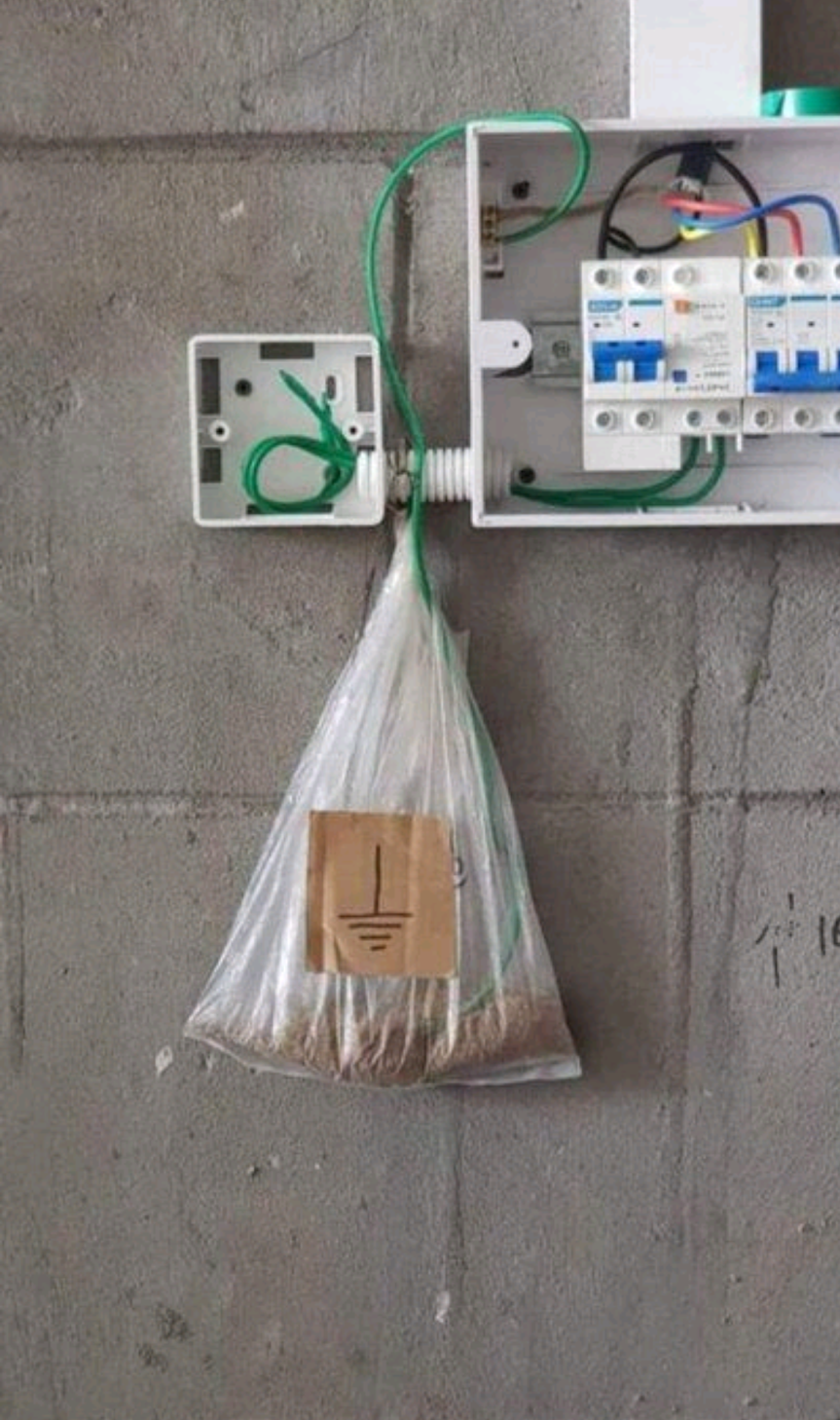
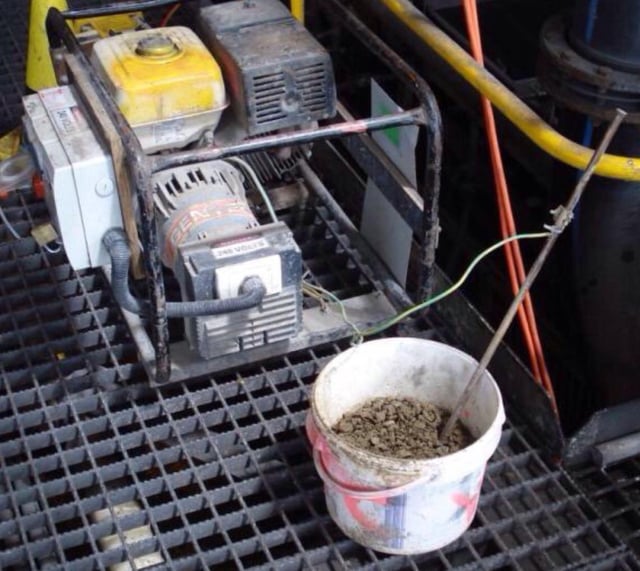
The “Pin 1 Problem” Multiplied: Why We Must Solve the AES59 Grounding Trap
By Anthony P. KuzubChair, AES-X249 Task Group SC-05-05-A
In the world of professional audio, the transition from XLRs to high-density DB25 connectors was a matter of necessity. We needed more channels in smaller spaces. But in adopting the AES59 standard (often called the TASCAM pinout), the industry inadvertently created a trap—an 8-channel variation of a problem we thought we had solved decades ago. Continue reading →
The Protocol-Driven Stage: Why SDP Changes Everything for Live Sound
For decades, the foundation of a successful live show has been the patch master—a highly skilled human who translates a band’s technical needs (their stage plot and input list) into physical cables. The Festival Patch formalized this by making the mixing console channels static, minimizing changeover time by relying on human speed and organizational charts.
But what happens when the patch list becomes part of the digital DNA of the audio system?
The demonstration of embedding specific equipment metadata—like the microphone model ($\text{SM57}$), phantom power ($\text{P48}$), and gain settings—directly into the same protocol (SDP) that defines the stream count and routing, paves the way for the Automated Stage. Continue reading →
How the lessons of the 19th-century workshop explain the future of AMWA NMOS and the shift to a Service Economy.
In the mid-19th century, Sir Joseph Whitworth gave the world a standard for the screw thread. It was a masterpiece of order, intended to make the mechanical world predictable. But while Britain invented the standard, it lost the manufacturing war. Why? Because British workshops refused to let go of “The Fitter.” Continue reading →
AES Member Profile
Anthony Kuzub
Anthony Kuzub
Job Title: Sr. Systems Designer
Company: CBC / Radio- Canada
Status: Member
Member since: 2009
Technical Committee: Network Audio Systems
Standards Committees: SC-02-01 (Digital Audio Measurement Techniques), SC-02-02 (Digital Input/Output Interfacing), SC-02-02-K (Multichannel audio in AES3, X196), SC-02-02-L (MADI over twisted-pair cabling), SC-02-08 (Audio File Transfer and Exchange), SC-02-08-E (X212 HRTF file format), SC-02-12 (Audio Applications of Networks), SC-02-12-H (AES-X192), SC-02-12-J (Network Use Cases), SC-02-12-L (Open Control Architecture), SC-02-12-M (AES67 development), SC-02-12-N (Media network directories), SC-02-12-P (Broadcast and Online Delivery), SC-02-12-Q (Streaming Loudness), SC-02-12-R (Streaming audio metadata over IP), SC-03-06 (Digital Library and Archive Systems), SC-03-12 (Forensic Audio), SC-04-03 (Loudspeaker Modeling and Measurement), SC-04-04 (Microphone Measurement and Characterization), SC-04-04-D (Project AES-X42), SC-04-04-E (Microphone comparisons), SC-04-08 (Sound systems in rooms), SC-05-02 (Audio Connectors), SC-05-02-F (Fiber optic), SC-05-05 (Grounding and EMC Practices)
Primary Section: Toronto
Company Website: http://www.CBC.ca
Other Professional Website: http://www.TorontoAES.org
Personal Website: https://like.audio
Contact: Anthony Kuzub
Audio Fields:
Broadcasting – Television Sound
Broadcasting – Studio
Broadcasting – Transmission
Broadcasting – Radio
Job Duties:
Designer
System Designer
About
Vice Chair Toronto AES 2017-2019
Chair Toronto AES 2019-2021
Bio:ANTHONY KUZUB updated May 2021
Anthony is a 3rd generation recording / broadcasting engineer. Obsessed with audio from a young age, he studied Ward-Beck Systems console schematics while his dad worked at CFQC-TV in Saskatoon. He maintains WBSps.ca , a Preservation Society whose members collate tech info and documentation about the legendary Toronto manufactured broadcast equipment. After 15 years of owning studios, producing music, mixing for IATSE 300, and refurbishing consoles he moved from Saskatoon to Toronto. In 2010 Anthony commissioned Revolution Recording as their Technical Supervisor. While Rush was recording in studio A, he built a custom Ward-Beck Systems Mixing Console for C. Anthony consulted, upgraded and designed audio equipment for community pillar like Livewire, Joao Carvalho Mastering, Lacquer Channel, many private individuals and studio visitors.
In 2016 he earned an Honors Diploma in Communication Engineering from Seneca Toronto.
Upon graduation, Anthony worked as the IP audio product manager for Toronto’s Ward-Beck.Systems. While taking on the role as Chair of the Toronto Audio Engineering Society (www.TorontoAES.org) he designed networked audio systems for railroads, broadcast plants, transmitter sites, production studios and virtualized production environments. Most notably were his contributions in an AES70 commanded remote controlled microphone pre-amp with AES67 transceivers meeting SMPTE 2110-30 compliancy. Anthony has designed, engineered, manufactured and supplied the highest quality broadcast and studio equipment to television and radio broadcasters worldwide.
As of 2020 Anthony has been working with the Canadian Broadcasting Corporation to design systems to best implement Audio Engineering Society standards. Leading projects with engineering Solution for the Media technology and infrastructure services. Anthony’s current portfolios include real time and file transport of production audio for radio, television and digital production.
Anthony is actively involved in the technical development of audio and media control standards.
Timeline;
1997-2010 – Recording studio Producer / Engineer: High Voltage Recording – Tanda Recording
2003-2018 – Audio Technician: Bell Media, IASTE 300
2010-2013 – Revolution Recording + Custom shop – Technical Supervisor – Console restoration
Ward-Beck Systems Mixing Console for their third room. Livewire, Joao Carvalho
Mastering, and Lacquer Channels Cutting system.
2013-2016 – Honors Diploma in Communication Engineering – Seneca Toronto.
2019 – Author – AES72-2019: AES standard on interconnections – Application of RJ45-type connectors and quad twisted pair cable for audio interconnections.
2014-2019 – IP audio product manager – Ward-Beck.Systems Toronto
2019 – Chair AES SC-05-05 – EMC practices
2020-present – CBC Radio Canada
Education Background
Seneca College of Applied Arts and Technology:
A comprehensive investigation of electronic circuitry, diagnostic techniques, applied mathematics, process control, and computer systems/networks. An advanced study of communication topics, including digital and data communications, the characteristics of signals and transmission media, cellular wireless systems, as well as broadband to the home.
This is a 3 year program that provides 30% hands—on laboratory work.
Program link: http://www.senecacollege.ca/fulltime/ELM.html
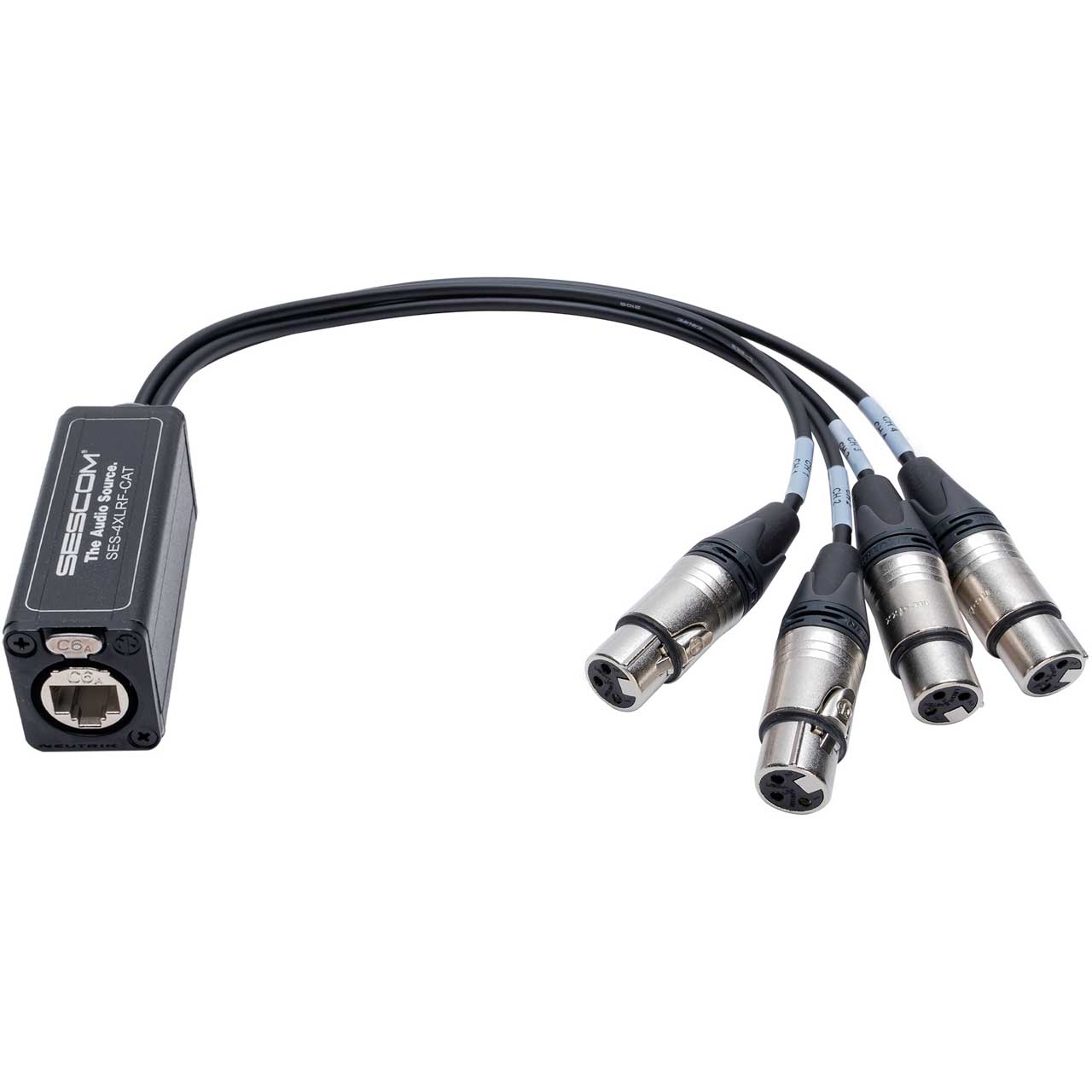
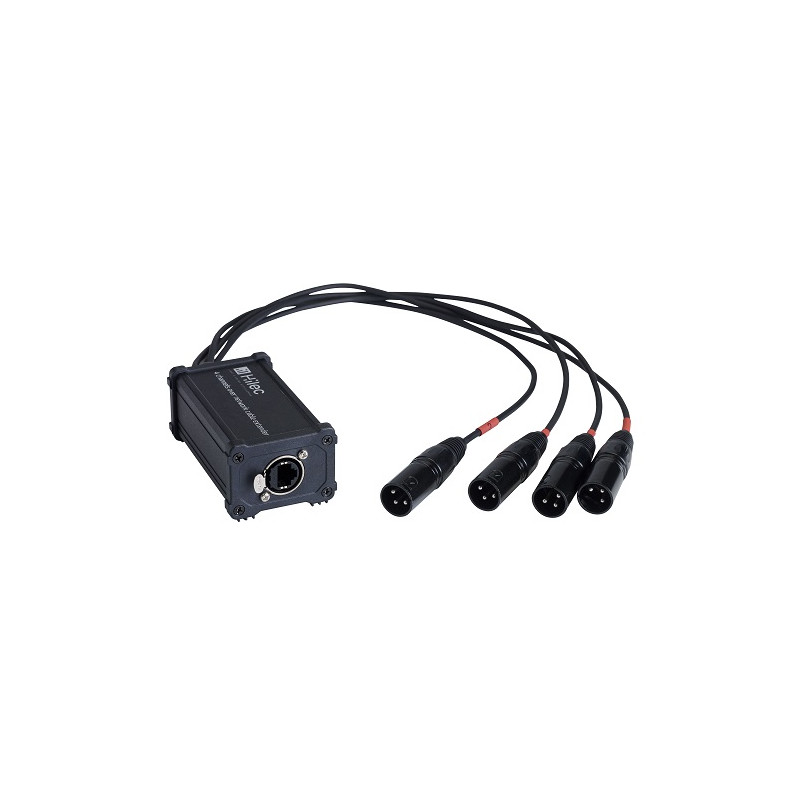
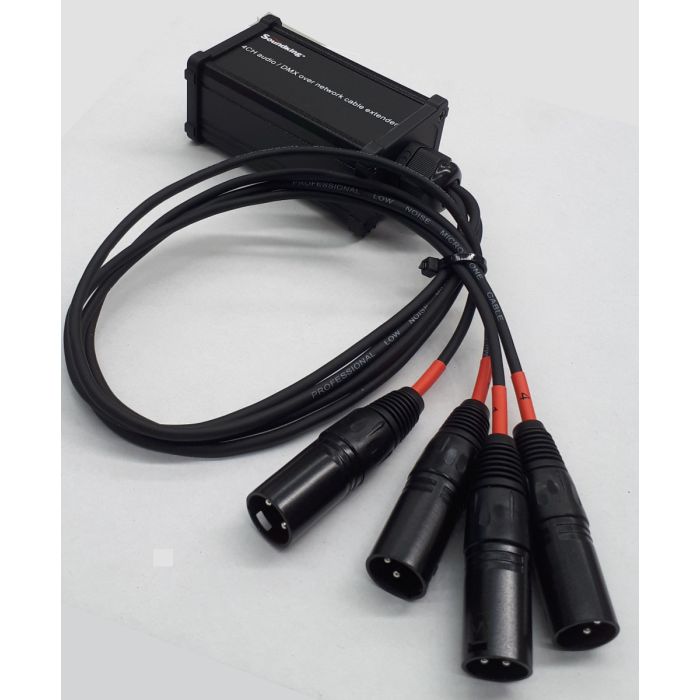
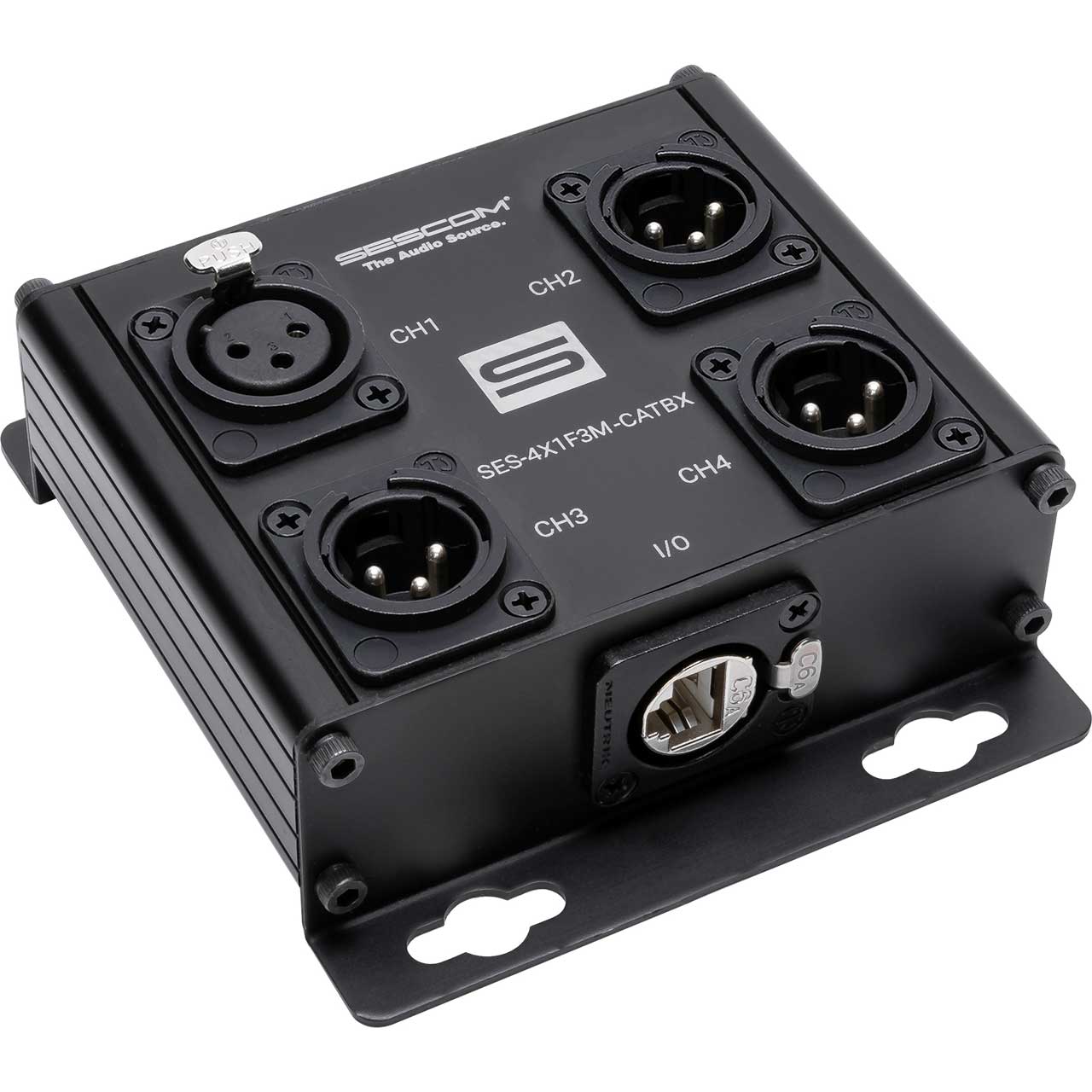
The NA-4I4O-AES72 is a 4-channel stagebox for transmitting microphone levels, analog line levels, AES3, DMX or even intercom via one single CAT cable. The device has male and female XLRs in the same housing and can be used directly as a splitter for monitoring. An additional etherCON serves as feedthrough and allows further looping of the signals to other devices. A ground lift at each input prevents possible ground loops. In addition, each input connector offers the possibility to invert the signal.