
Crawler.like.audio
https://github.com/LikeDotAudio/Crawler.Like.Audio
Inside the Browser Sandbox: A Deep Dive into Crawler.Like.Audio
The era of heavy desktop applications and bloated backend servers for local development tasks is being challenged. Enter Crawler.Like.Audio, a powerful, 100% client-side developer utility suite that pushes the limits of modern browser APIs. Built entirely with Next.js, TypeScript, and WebAssembly, this static application runs securely within the browser’s execution thread—requiring zero local installations and absolutely no backend dependencies.
Divided into nine hyper-capable modules, the suite transforms the web browser into a comprehensive toolkit for codebase analysis, security auditing, and hardware scanning. Here is a look at how every page works under the hood.
Codebase Exploration and Management
At the heart of Crawler.Like.Audio are tools designed to seamlessly interact with, analyze, and rebuild your local file system directly from the browser.
-
File Crawler: The core engine relies on the modern File System Access API to read local directories. When you select a folder, it performs a lightning-fast pre-scan, recursively streaming files to categorize them by type (Programming, Web & Markup, Data & Config, Docs) and calculate byte sizes. A real-time pie chart allows for selective crawling. Once configured, the deep crawl extracts file text and runs AST (Abstract Syntax Tree) parsing on supported languages via WebAssembly, ultimately compiling a massive
EVERYTHING.LOGscrape file and aMAP.txtdirectory tree. 

-
Program Map: For a high-level overview devoid of visual noise, this module displays a pure, text-based directory tree of your project. Functioning similarly to the Linux
treecommand, it offers a clean, structural skeleton of your deep crawl.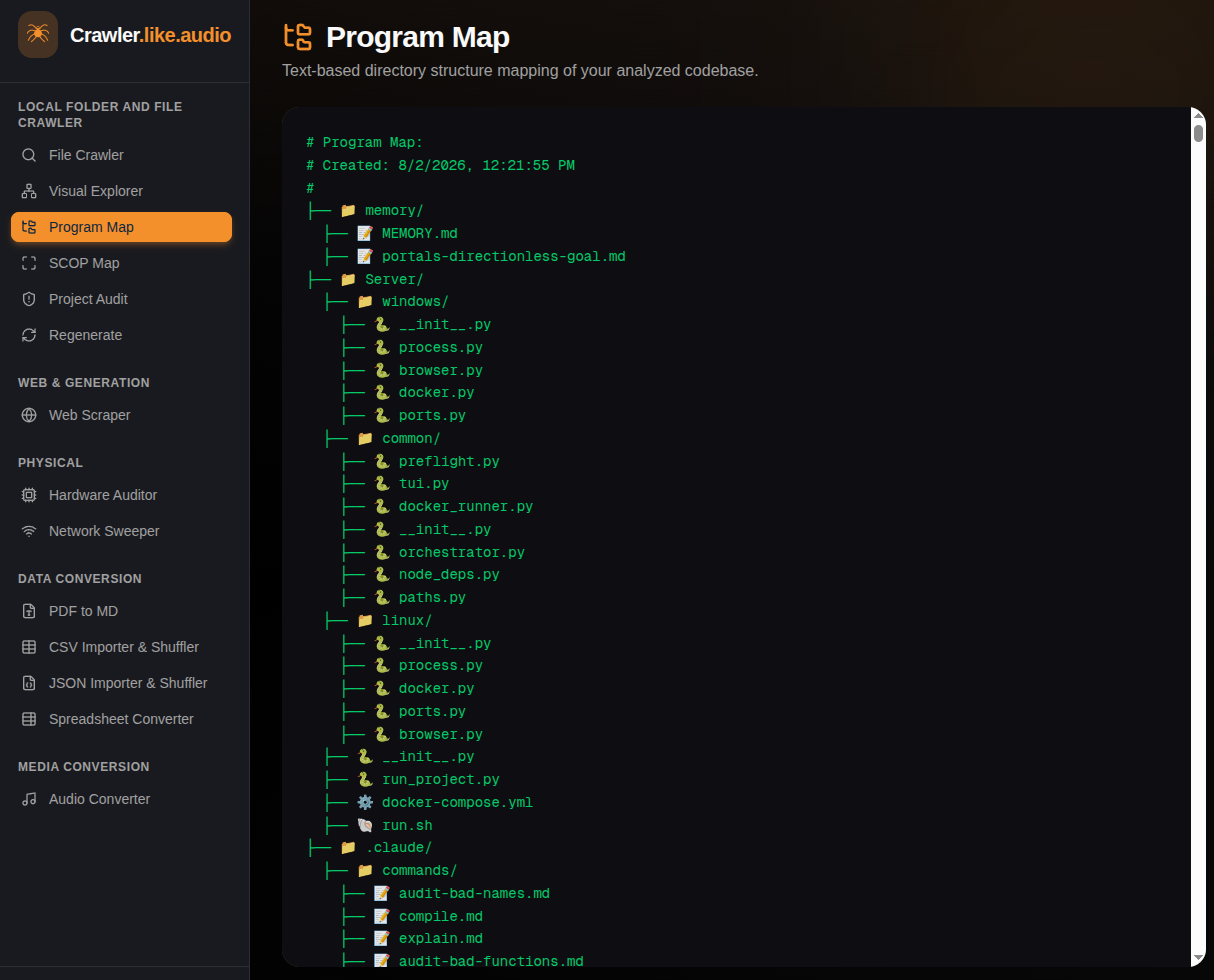
-
Visual Explorer: Taking the raw data from the File Crawler, this module uses React Flow to generate a highly interactive, drag-and-drop node graph. It visualizes your codebase architecture, mapping exactly how folders connect to files, and how those files branch into specific classes and functions.

-
Project Regenerator: Acting as the inverse of the File Crawler, the Regenerator takes an
EVERYTHING.LOGfile (whether generated by an AI or the crawler itself) and unpacks it. By selecting an empty destination folder, the utility uses the File System Access API to physically rebuild the folders and write the files back to your local disk.
Security, Network, and Hardware Auditing
Traditionally, network sweeps and hardware audits required native OS permissions. Crawler.Like.Audio leverages cutting-edge web standards to bring these capabilities into the sandbox.
-
Project Audit: A purely client-side security tool. Its secrets scanner uses advanced regex heuristics to hunt down exposed API keys, passwords, cryptographic tokens, and rogue
.envvariables. Additionally, the endpoint extractor maps out your app’s external dependencies by ripping through code to find hardcoded URLs, IP addresses, and API endpoints.
-
Hardware Auditor: This module hooks deeply into native hardware APIs to act as a physical peripheral scanner. It utilizes the WebUSB API to discover authorized USB devices, Web Bluetooth (BLE) for radar sweeps of nearby beacons and smart TVs, the Web Serial API for RS-232 devices and Arduinos, and WebRTC to silently index every connected camera and audio output.

-
Network Sweeper: A clever browser-based LAN scanner. Because browsers cannot open raw TCP/UDP sockets, this tool maps your local network (e.g.,
192.168.1.x) using cross-origin HTTP fetches. By measuring precise timeout and connection-refused response times—a localized timing attack—it heuristically discovers routers, IoT devices, or local web servers.
Content Extraction Utilities
The suite is rounded out by lightweight, privacy-first data extraction tools.
-
Web Scraper: Enter any public URL, and the scraper fetches the raw HTML. It then utilizes client-side parsing via Turndown to strip away web noise, instantly converting the page into clean, readable Markdown.

-
PDF to MD: A drag-and-drop local document extractor. Powered by a WebAssembly port of
pdfjs-dist, it locally extracts text strings from PDFs and formats them into Markdown. Because everything happens in Wasm, sensitive documents are never uploaded to a cloud server. -
Data Converters (CSV / JSON / Spreadsheet)
A powerful suite of data ingestion and shuffling utilities built with `papaparse` and `xlsx` (SheetJS).
* **CSV & JSON Importer/Shuffler:** Flatten or nest massive JSON objects, randomize CSV columns, and instantly export data.
* **Spreadsheet Converter:** Read natively complex spreadsheet binaries (`.xlsx`, `.csv`, `.ods`, `.numbers`) and convert them into clean formats, directly in the client.
### 12. 🎵 Audio Converter
A robust browser-side media encoder leveraging native Web Audio APIs and CDN-imported `lamejs`.
* **Universal Decode:** Drops any modern audio file (`.wav`, `.flac`, `.m4a`) to instantly decode its buffer.
* **Client-side Encoding:** Re-encodes the raw audio into an optimized `.mp3` file, relying strictly on your CPU’s client-side processing without uploading the audio file anywhere.